.webp)
What Is Arraignment in Florida? A Guide from a Tampa Criminal Defense Attorney

If you have been arrested or received a notice to appear in criminal court, one of the first court dates you may encounter is an arraignment. Many people facing criminal charges in Florida understandably feel anxious about this hearing and wonder what to expect.
The good news is that an arraignment is usually a brief procedural hearing, not a trial. No witnesses testify, no jury is present, and the judge does not decide guilt or innocence at this stage. Still, what happens at an arraignment can affect the direction of your criminal case.
As a Tampa criminal defense attorney, I often help clients navigate this important step in the criminal justice process. Here is what you need to know about arraignment in Florida.
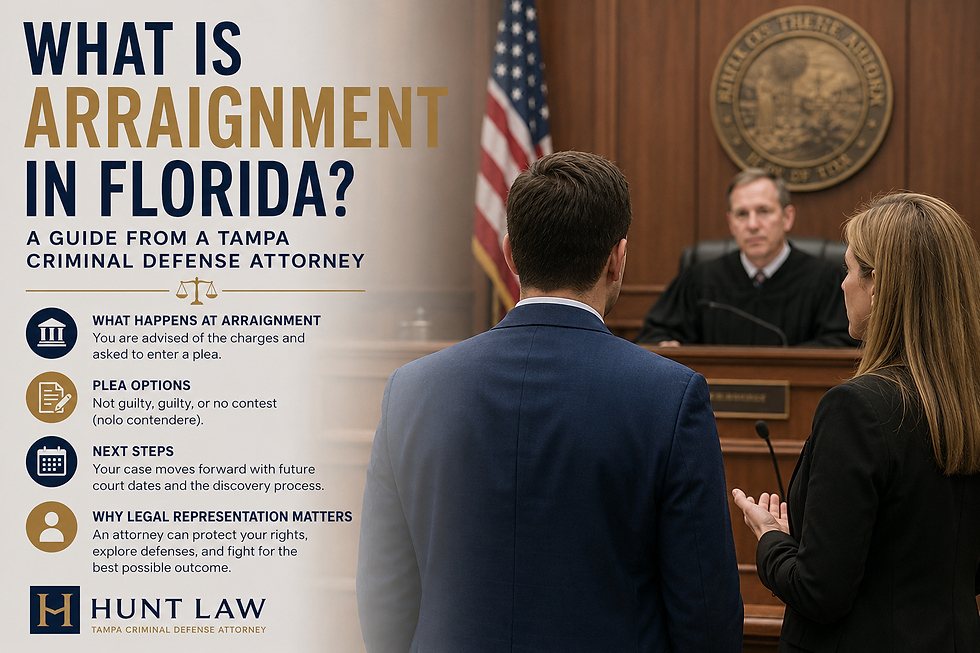
What Is an Arraignment?
An arraignment is a formal court hearing where the court officially advises a defendant of the criminal charges filed against them and asks the defendant to enter a plea. In Florida, arraignments are governed by Florida Rule of Criminal Procedure 3.160. Under this rule, the court must either read the charging document, or summarize the substance of the charges, and ask the defendant how they plead.
In practical terms, arraignment serves three main purposes:
Formally informing you of the charges
Providing an opportunity to enter a plea
Moving the case into the next phase of litigation
For many people, the arraignment is their first formal court appearance after charges have officially been filed by the State Attorney’s Office.
What Happens During an Arraignment in Florida?
Most arraignments are relatively quick and straightforward.
During the hearing, the judge will typically:
Call your case
Confirm your identity
Inform you of the criminal charges
Advise you of your right to counsel
Ask for your plea
Set future court dates if necessary
Florida law allows arraignments to take place either in open court or by audio-video communication technology, depending on the court’s procedures.
In Hillsborough County, many misdemeanor and felony arraignments move quickly, especially when a defendant is represented by counsel.
What Pleas Can Be Entered at Arraignment?
At arraignment, a defendant generally has three plea options:
1. Not Guilty
In most criminal cases, a not guilty plea is the appropriate choice at arraignment.
Pleading not guilty does not mean you are claiming innocence under oath. It simply means you are requiring the State of Florida to prove its case and preserving your legal rights.
After a not guilty plea, the case usually proceeds to:
Discovery
Pretrial hearings
Motion practice
Negotiations
Potential trial
An experienced Tampa criminal defense attorney can then begin reviewing evidence, investigating defenses, challenging weaknesses in the prosecution’s case, and negotiating with prosecutors.
2. Guilty
A guilty plea is an admission to the offense charged.
If you plead guilty, the judge may immediately sentence you or set the case for sentencing at a later date.
In most situations, pleading guilty at arraignment without first consulting a criminal defense lawyer is a mistake, because you may not yet understand:
Potential defenses
Immigration consequences
Driver’s license implications
Professional licensing issues
Collateral consequences
Diversion opportunities
3. No Contest (Nolo Contendere)
A no contest plea means you are not contesting the charge, but you are also not expressly admitting guilt.
In Florida criminal court, the practical effect of a no contest plea is often similar to a guilty plea because the judge can still impose a sentence.
Do You Have to Attend Arraignment in Florida?
Not always.
One of the most misunderstood aspects of Florida criminal procedure is that many arraignments can be waived.
Under Florida Rule of Criminal Procedure 3.160, a defendant represented by counsel may often avoid appearing at arraignment if their attorney files a written plea of not guilty and waiver of appearance with the court.
This can be especially helpful for people who:
Have jobs and cannot miss work
Live out of town
Want to avoid unnecessary courtroom appearances
Feel overwhelmed by the court process
In many cases, I appear on behalf of clients so they do not have to physically attend the arraignment.
However, whether arraignment can be waived depends on the specific charge, judge, and court policies.
Is Arraignment the Same as First Appearance?
No, and many people confuse the two.
A first appearance occurs shortly after an arrest if someone remains in custody. Under Florida law, a person generally must be brought before a judge within 24 hours of arrest.
At first appearance, the judge determines:
Pretrial release terms
Whether a no-contact order should be imposed
Arraignment
Arraignment happens later, after formal charges have been filed.
Its purpose is different: the court formally advises the defendant of the charges and obtains a plea.
In short:
First Appearance = bond and release issues
Arraignment = formal plea and case progression
Understanding this distinction is important when navigating a criminal case.
Can Charges Be Dropped at Arraignment?
Usually, no.
Many people hope the judge will dismiss the case at arraignment, but that is uncommon.
Arraignment is generally not the stage where evidence is argued or where witnesses testify. Instead, it is a procedural hearing focused on formally beginning the litigation process.
That said, hiring a lawyer early can still make a major difference. A skilled Tampa criminal defense attorney may identify legal issues, evidentiary weaknesses, constitutional violations, or opportunities to resolve the case before trial.
In some situations, prosecutors later decide to reduce or dismiss charges after further investigation or negotiations.
Why Hiring a Lawyer Before Arraignment Matters
One of the biggest mistakes people make is waiting too long to hire counsel.
The earlier a defense attorney becomes involved, the more opportunities there may be to:
Preserve favorable evidence
Communicate with prosecutors early
Seek diversion programs
Investigate witnesses
File pretrial motions
Develop defense strategies
Early intervention often produces better outcomes.
As a former Division Chief of the Hillsborough County Public Defender's Office and experienced Tampa criminal defense attorney, I understand how local criminal courts operate and how to begin building a defense strategy from day one.

Contact a Tampa Criminal Defense Attorney
If you have been charged with a crime and are facing arraignment in Hillsborough County or the surrounding Tampa Bay area, it is important to understand your rights and options before stepping into court.
At Hunt Law, we provide aggressive, strategic criminal defense representation for people accused of misdemeanors and felonies throughout Tampa and Hillsborough County.
Contact Hunt Law today for a free, confidential consultation with an experienced Tampa criminal defense attorney.



Comments