top of page
.webp)
Criminal Law Deep Dives
Take an in-depth look at specific issues that commonly arise in Florida criminal cases.


Arrested in a Prostitution Sting in Tampa, FL? What Happens Next?
Prostitution and solicitation cases often arise from planned undercover operations in which law enforcement controls much of the interaction. That means the messages, recordings, surveillance, and conduct of the undercover officer can become important evidence in determining whether the State can actually prove the charge.
J. Ruffin Hunt
3 days ago8 min read


A Florida Detective Called and Wants to Talk—What Should I Do?
A Florida detective called, texted, or asked you to come in for questioning. Learn whether you must respond, what not to say, and when to contact a criminal defense attorney.
J. Ruffin Hunt
Aug 238 min read


How to Find the Best Criminal Defense Attorney in Tampa
If you have been arrested or accused of a crime, choosing a lawyer may be one of the most important decisions you make. A criminal case can affect your freedom, employment, professional licenses, reputation, driving privileges, and future opportunities. Yet most people searching for a criminal defense attorney have never hired one before.
So how do you find the best criminal defense attorney in Tampa for your case?
J. Ruffin Hunt
Aug 1913 min read


16 Arrested in Tampa-Area Street Takeover: What Florida Drivers Should Know About Street Racing Charges
A large Florida Highway Patrol operation in Hillsborough County recently resulted in 16 arrests following what authorities described as a coordinated street takeover, highlighting just how serious Florida's laws governing street racing, stunt driving, and street takeovers have become.
J. Ruffin Hunt
Aug 176 min read


What Happens If You're Charged With Possession of Child Sexual Abuse Material (CSAM) in Florida?
Being investigated or arrested for possession of child sexual abuse material (CSAM)—referred to as "child pornography" throughout many Florida statutes—is one of the most serious situations a person can face in the criminal justice system. These investigations often involve extensive digital forensic examinations, search warrants, and the seizure of computers, smartphones, tablets, external hard drives, cloud storage accounts, and other electronic devices.
J. Ruffin Hunt
Aug 620 min read


Can the Police Charge You Without Evidence in Florida?
If you have been arrested—or believe you are under investigation—you may be wondering:
"Can the police charge me with a crime if they don't have any evidence?"
The short answer is not exactly.
Police officers cannot lawfully arrest or recommend criminal charges based on mere suspicion alone. However, the amount of evidence required to make an arrest is far less than the amount of evidence required to obtain a criminal conviction.
J. Ruffin Hunt
Aug 25 min read


How to Get a Bond Reduced in Florida
If you or a loved one is being held in the Hillsborough County Jail or another Florida detention facility because the bond is simply too high, understanding how bond reduction hearings work can help you know what to expect—and how an experienced Tampa criminal defense attorney can advocate for your release.
J. Ruffin Hunt
Aug 17 min read


The Hidden Costs of a Florida Drug Trafficking Conviction: More Than Just Prison Time
When most people hear the term "drug trafficking," they immediately think about lengthy prison sentences. While incarceration is certainly one of the most serious consequences of a conviction, it is far from the only one. A Florida drug trafficking conviction can have lasting financial, professional, and personal consequences that continue long after a person has completed a sentence.
J. Ruffin Hunt
Jul 305 min read


Misdemeanor Probation in Hillsborough County, Florida: What You Need to Know
Being placed on misdemeanor probation in Hillsborough County can allow a defendant to avoid serving additional time in jail, but probation should not be confused with simply having a case behind you. While on probation, a defendant remains under court supervision and must comply with specific conditions until the probationary period ends or the court terminates probation.
J. Ruffin Hunt
Jul 278 min read


What Is "Meg's Law" in Florida? Understanding the State's New Nitrous Oxide and Xylazine Law
Learn how Florida's new Meg's Law creates felony nitrous oxide offenses and xylazine trafficking charges, and what it means if you've been arrested.
J. Ruffin Hunt
Jul 154 min read


Florida's New "Officer Jason Raynor Act": What the Law Means for Criminal Defendants
Learn how Florida's new Officer Jason Raynor Act changes resisting arrest laws, enhances penalties, and impacts criminal cases involving law enforcement officers.
J. Ruffin Hunt
Jul 124 min read


Florida's New "Missy's Law" (HB 445): Mandatory Custody After Conviction for Certain Dangerous Crimes
Learn about Florida’s new Missy’s Law (HB 445), effective July 1, 2026, and how it changes custody rules after convictions for dangerous crimes. Tampa criminal defense attorney J. Ruffin Hunt explains what the new law means.
J. Ruffin Hunt
Jul 94 min read


Florida’s New Isaiah’s Law (HB 35): How the Law Expands Habitual Traffic Offender Penalties
Florida’s new Isaiah’s Law (HB 35) expands Habitual Traffic Offender penalties for repeat drivers without a valid license. Learn what changed and how it may impact Florida drivers.
J. Ruffin Hunt
Jul 74 min read


Can Criminal Charges Be Dropped/Dismissed in Florida?
In Florida, criminal charges may be dismissed for a variety of legal reasons. Sometimes the State Attorney's Office decides there is not enough evidence to continue prosecuting the case. In other situations, a defendant successfully completes a diversion program, or a judge dismisses the charges after granting a motion filed by the defense.
Understanding how criminal charges may be dismissed can help you better understand the criminal justice process and what options may be a
J. Ruffin Hunt
Jul 26 min read


How Criminal Traffic Charges Can Affect a Commercial Driver's License (CDL) in Florida
If you're a CDL holder facing criminal traffic charges in Tampa, Hillsborough County, or the surrounding areas, Hunt Law provides experienced representation for criminal traffic offenses and understands the unique consequences these cases can have on commercial drivers.
Call (813) 787-4849 today for a free consultation to discuss your case and your options.
J. Ruffin Hunt
Jul 14 min read


What is a Misdemeanor in Florida?
What is a misdemeanor in Florida? Learn the difference between first- and second-degree misdemeanors, potential penalties, common charges, and what happens after an arrest.
J. Ruffin Hunt
Jun 234 min read


Do I Need a Lawyer If Charges Haven’t Been Filed Yet?
Under investigation or arrested but charges haven’t been filed? Learn how a Tampa criminal defense attorney may help protect your rights and advocate against charges.
J. Ruffin Hunt
Jun 144 min read


What Happens If I Miss Court in Tampa?
If you missed a court date in Tampa or Hillsborough County, it is important to speak with an experienced criminal defense attorney as soon as possible.
J. Ruffin Hunt
Jun 133 min read


Tampa Battery Second or Subsequent Attorney
Charged with battery second or subsequent in Tampa? Learn penalties, defenses, and how a Tampa battery attorney can help fight felony battery charges.
J. Ruffin Hunt
Jun 94 min read
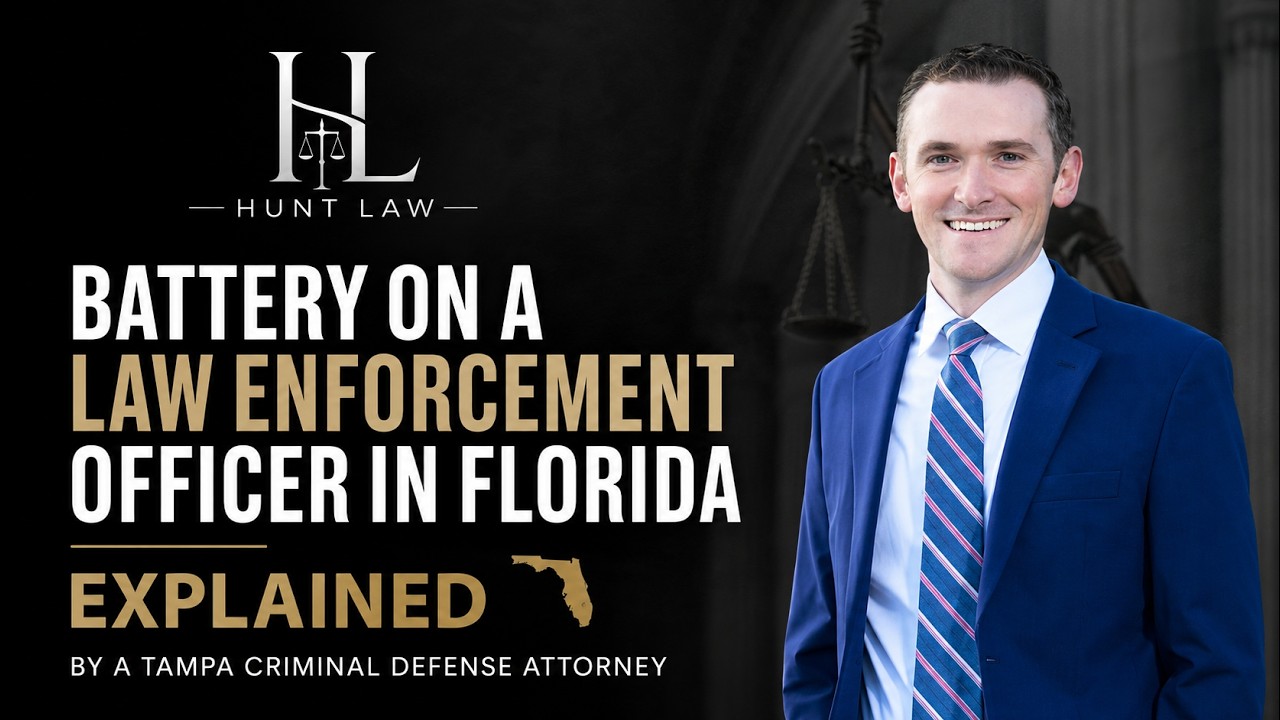
Battery on a Law Enforcement Officer in Florida
In this video, Tampa criminal defense attorney Ruffin Hunt of Hunt Law explains the law surrounding Battery on a Law Enforcement Officer (LEO) and Aggravated Battery on a Law Enforcement Officer under Florida law.
J. Ruffin Hunt
Jun 42 min read
bottom of page